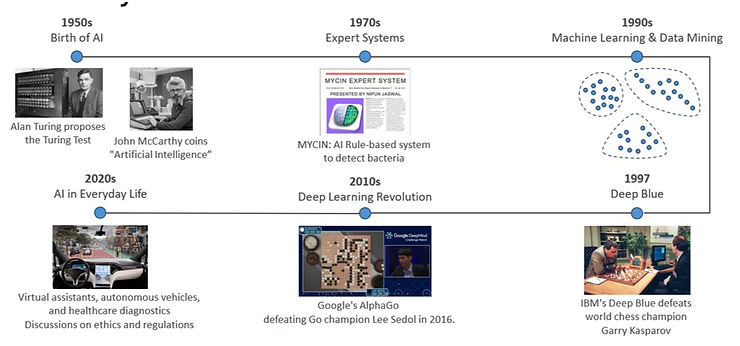
Artificial Intelligence (AI) has evolved remarkably over the decades, transforming from theoretical concepts to a driving force behind modern technological advancements. Its journey began in the 1950s when Alan Turing introduced the idea of machine intelligence with the Turing Test, and John McCarthy coined the term "Artificial Intelligence." The 1970s saw the rise of expert systems like MYCIN, which applied rule-based logic to problem-solving. By the 1990s, machine learning and data mining gained prominence, culminating in IBM’s Deep Blue defeating world chess champion Garry Kasparov in 1997. The 2010s marked the deep learning revolution, with AI systems like Google’s AlphaGo surpassing human intelligence in complex games. Today, AI is an integral part of daily life, powering virtual assistants, autonomous vehicles, and advanced healthcare diagnostics, while sparking critical discussions on ethics and regulations. This historical progression underscores AI’s transformative impact, setting the stage for its role in enterprise success, particularly in AI-enhanced information management.
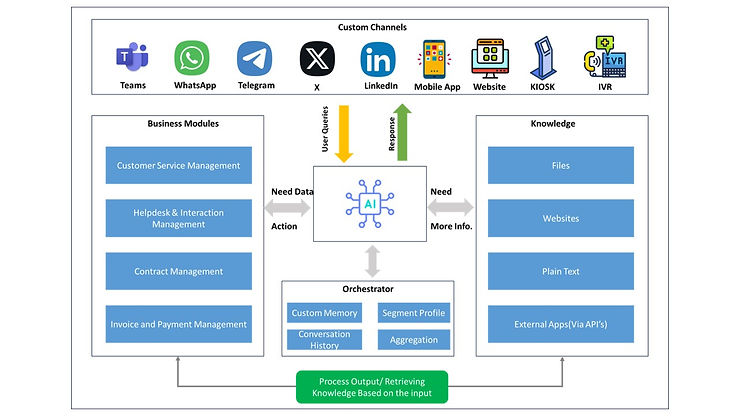
The evolution of cloud computing through Infrastructure as a Service (IaaS), Platform as a Service (PaaS), and Software as a Service (SaaS) has transformed how enterprises manage their IT resources, paving the way for AI to revolutionize information management. IaaS provides the foundational layer, offering virtualized servers, storage, and networking, which businesses traditionally managed on-premises. PaaS builds on this by adding runtime environments, middleware, and operating systems, enabling developers to focus on building applications without worrying about underlying infrastructure. SaaS takes it further, delivering fully managed applications and data directly to users, streamlining operations. As these cloud models matured, AI began to integrate seamlessly across these layers, enhancing data processing, automating workflows, and providing intelligent insights. This synergy between cloud services and AI has empowered enterprises to optimize information management, driving efficiency, innovation, and success in an increasingly data-driven world.
As I delve into AI trends based on discussions with global telecom, government, and utility providers, it is clear that enterprises are increasingly seeking AI-driven solutions to efficiently manage vast information repositories. In the context of the architecture I have analysed, I will highlight how AI is transforming knowledge retrieval, optimizing service delivery, and enhancing decision-making across these sectors.
Unlike traditional static databases, AI-powered knowledge bases offer dynamic capabilities to aggregate, structure, and retrieve information in real time. These systems seamlessly integrate data from diverse sources, including enterprise applications, customer interactions, and external data streams. By continuously learning and adapting, they provide contextually relevant responses, improving both operational efficiency and user experience. This evolving trend reflects a broader shift towards AI technologies that can rapidly process, analyze, and utilize information, driving smarter and more responsive business operations across industries.
Impact of AI in Enterprise
Through my engagements with global enterprises, I have observed how AI-driven knowledge bases analyse historical customer interactions, detect patterns in queries, and automate responses across digital channels such as chatbots, websites, and interactive voice response (IVR) systems. In the telecom industry, for example, AI systems provide real-time resolution to customer issues, reducing reliance on human agents for repetitive tasks.
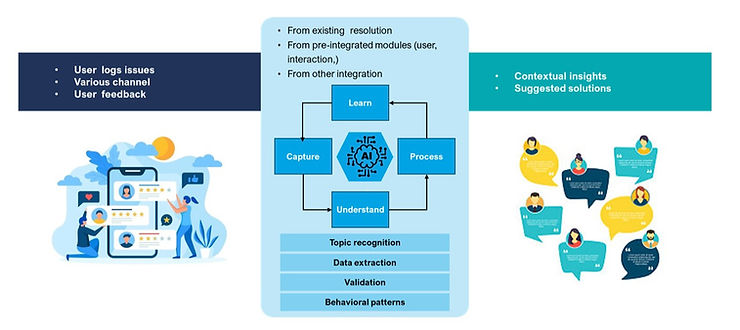
The integration of AI into enterprise systems is vividly illustrated through a dynamic process that enhances decision-making and operational efficiency. AI captures data from diverse sources such as existing resolutions, pre-integrated modules, and other integrations, alongside user-generated inputs like logs, issues, and feedback. This data undergoes a sophisticated process where AI learns, understands, and extracts meaningful insights through topic recognition, data extraction, validation, and analysis of behavioural patterns. The result is a powerful output of contextual insights and suggested solutions, enabling enterprises to address challenges proactively, optimize workflows, and deliver personalized user experiences. By leveraging AI in this way, businesses can transform raw data into actionable intelligence, driving innovation and success in a competitive landscape.
Similarly, in the utilities sector, AI-powered knowledge repositories provide real-time outage updates, analyse energy consumption trends, and recommend personalized cost-saving strategies. In government agencies, AI-driven self-service portals help citizens access public records, policy documents, and tax-related information, thereby enhancing operational efficiency and public engagement.
AI Integration with Enterprise Applications
A crucial aspect of AI-driven knowledge bases is their ability to seamlessly integrate with enterprise applications such as Customer Relationship Management (CRM), Enterprise Resource Planning (ERP), and IT Service Management (ITSM) systems. Through my research and discussions, I have seen enterprises benefit from AI-driven insights by pulling structured and unstructured data from these systems and processing it with Large Language Models (LLMs).
The architecture demonstrates a sophisticated framework where AI acts as the central intelligence layer, seamlessly bridging diverse enterprise systems to optimize operations and deliver significant business benefits. The AI integrates with communication and collaboration platforms like Microsoft Teams, WhatsApp, Slack, X, LinkedIn, and IVR systems, enabling it to ingest real-time data from key enterprise functions. These include customer service management for handling client inquiries, helpdesk and interaction systems for managing technical support, contract management for overseeing agreements, and invoice and payment management for tracking financial transactions. By leveraging custom memory, conversation history, and segment profile aggregation, the AI processes this data to retain context, maintain interaction continuity, and categorize users based on behavior and preferences, ensuring a deep understanding of enterprise dynamics. On the output side, the AI interacts with external applications via APIs, managing files, websites, and plain text, which ensures compatibility with a wide range of tools. The "Process Output/Retrieving Knowledge Based on the Input" mechanism allows the AI to deliver actionable outcomes, such as automated responses, detailed reports, or decision-making insights, while maintaining a feedback loop to continuously improve its performance.
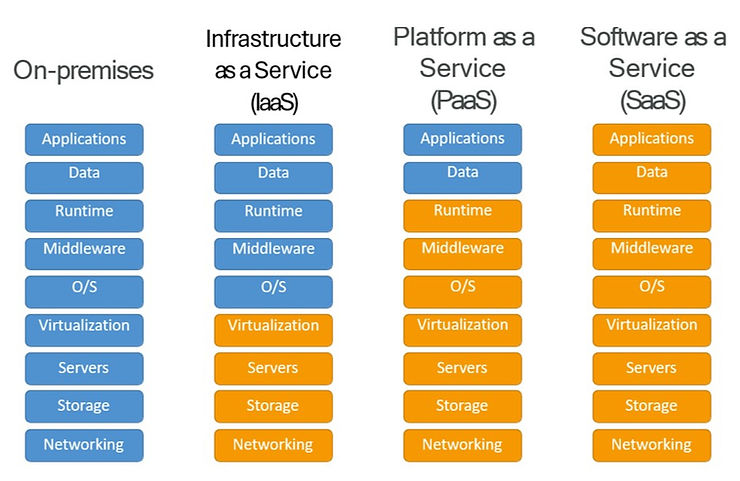
This integration yields substantial business benefits, including enhanced operational efficiency through automation of repetitive tasks like invoice processing or customer query resolution, reducing manual effort and errors. It improves customer satisfaction by enabling personalized, context-aware interactions, such as tailored support responses based on conversation history. The AI-driven insights from segment profiling and data aggregation empower enterprises to make informed decisions, optimize resource allocation, and identify new opportunities for growth. Additionally, the architecture breaks down silos between departments, fostering cross-functional collaboration and ensuring a unified view of operations. By streamlining workflows, reducing response times, and enhancing scalability through API-driven external integrations, businesses can achieve cost savings, improve agility, and maintain a competitive edge in a rapidly evolving market. Ultimately, this AI integration transforms enterprise applications into a cohesive, intelligent ecosystem that drives productivity, innovation, and long-term success.
Sample Use Cases per industry and Integrations
Challenges Vs Best practices
Way of addressing the Enterprise Reservations in Adopting AI
Standard LLM Models and Cost Considerations
So what next ?
As AI continues to evolve, knowledge bases will expand to support multimodal inputs—text, voice, and visual data. For instance, telecom providers are exploring AI-powered video guides for troubleshooting network issues. Utilities companies are using AI-powered voice assistants to deliver real-time energy insights. Government agencies are likely to adopt AI-driven virtual assistants to guide citizens through complex bureaucratic processes using augmented and virtual reality (AR/VR).
From my discussions with industry experts and analysis of AI-driven knowledge base projects, it is evident that AI is fundamentally reshaping how industries interact with their customers and stakeholders. Organizations looking to implement AI-powered knowledge bases must embrace continuous innovation, integrate with enterprise applications, and adopt best practices to ensure optimal performance. The future of knowledge management is AI-empowered, unlocking new levels of automation, intelligence, and user engagement.